

- Why ChatGPT Became a Key Technology Trend
- How ChatGPT Changes Human Computer Interaction
- ChatGPT as a Catalyst for Faster Innovation
- The Role of ChatGPT in Everyday Technology Use
- How ChatGPT Influences Software Development and IT Workflows
- Limitations and Risks of ChatGPT as a Technology
- The Future of Technology with ChatGPT
Why ChatGPT Became a Key Technology Trend
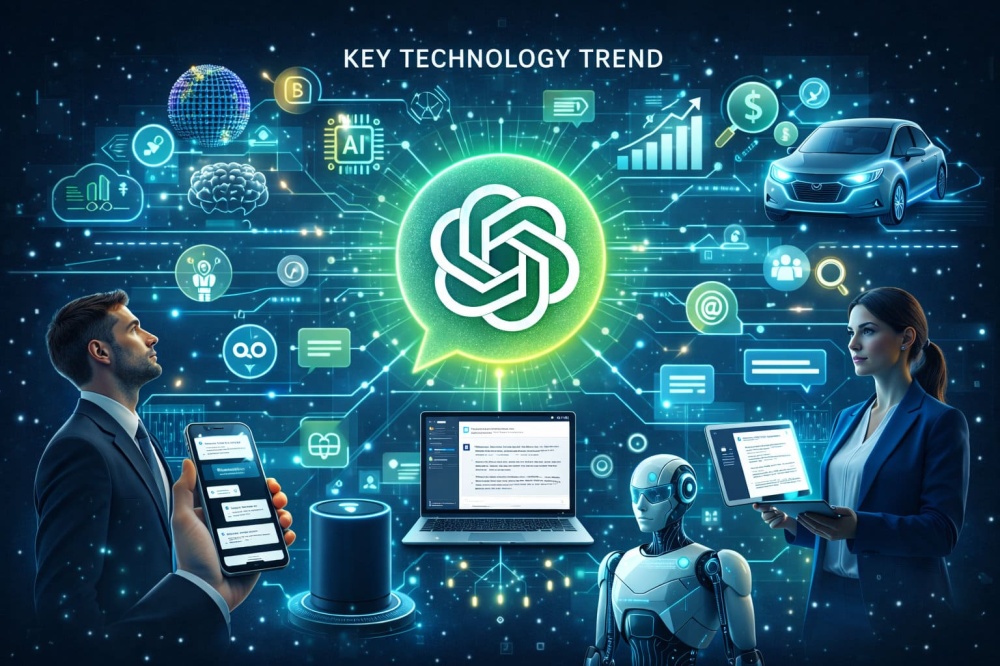
Technology evolves in waves, and artificial intelligence has become the defining wave of the current decade. ChatGPT stands out not simply as another AI product, but as a technology that directly interacts with millions of users on a daily basis. Unlike traditional software, it communicates, adapts, and learns patterns of human interaction.
What makes ChatGPT especially important for the tech landscape is accessibility. Advanced AI capabilities that once required specialized knowledge are now available through natural language. This shift changes how people perceive and use technology across industries.
For readers who want to explore how ChatGPT influences technology, productivity, and digital workflows in real-world scenarios, a large collection of in-depth and practical articles is available on https://lifeinfohub.de/, where AI tools are explained in a clear and applied way.
“Technology becomes transformative when humans can interact with it naturally.”
From an SEO perspective, search interest around ChatGPT technology, AI innovation, and future of AI tools continues to grow globally, making this topic highly relevant for a technology-focused blog.
How ChatGPT Changes Human Computer Interaction
For decades, interaction with technology relied on rigid interfaces such as menus, buttons, and command lines. ChatGPT represents a shift toward conversational interfaces, where users communicate intent rather than instructions.
This change reduces friction between humans and machines. Users no longer need to learn how software works internally; instead, the software adapts to how humans think and speak. This fundamentally alters user experience design across digital products.
ChatGPT also introduces contextual continuity. Conversations evolve, build upon previous inputs, and adapt dynamically. This is a significant departure from traditional systems that reset context with every interaction.
As a result, many tech companies now explore conversational layers on top of existing platforms. ChatGPT demonstrates how interaction design is moving away from complexity toward clarity and intent-driven workflows.
ChatGPT as a Catalyst for Faster Innovation
Innovation often slows down due to communication gaps between ideas and execution. ChatGPT helps close this gap by translating abstract concepts into structured outputs that developers, designers, and product teams can act upon.
In technology teams, ChatGPT accelerates brainstorming, documentation, and early-stage problem solving. Instead of starting from scratch, teams use AI-generated drafts as a foundation for refinement and improvement.
This acceleration does not remove the need for expertise. Instead, it amplifies human capabilities by reducing time spent on repetitive cognitive tasks. Innovation cycles become shorter and more iterative.
“Speed in innovation comes from removing unnecessary friction, not from replacing people.”
Because of this, ChatGPT is increasingly viewed as an innovation enabler rather than a replacement technology.
The Role of ChatGPT in Everyday Technology Use
ChatGPT is not limited to professional or technical environments. Its influence extends into everyday technology use, shaping how people interact with digital tools at home, work, and education.
Users rely on ChatGPT to understand complex technology topics, compare tools, and solve practical problems without searching through dozens of sources. This changes information consumption patterns and reduces dependency on traditional search behaviors.
The technology also lowers barriers for non-technical users. People without programming or engineering backgrounds can now interact meaningfully with advanced systems.
Common everyday technology use cases for ChatGPT include:
- Explaining complex technical concepts in simple language
- Assisting with software setup and troubleshooting
- Helping users choose between digital tools and platforms
This broad applicability reinforces ChatGPT’s role as a general-purpose technology interface.
How ChatGPT Influences Software Development and IT Workflows
In software development and IT operations, ChatGPT plays a supportive role across multiple stages of work. Developers use it to explore logic, review ideas, and clarify implementation approaches.
ChatGPT also improves communication between technical and non-technical stakeholders. By translating requirements into clear explanations, it helps align expectations and reduce misunderstandings.
In IT workflows, ChatGPT assists with documentation, system explanations, and procedural guidance. This improves knowledge sharing and reduces onboarding time for new team members.
“Clear understanding is the foundation of reliable systems.”
While ChatGPT does not replace development tools or infrastructure, it enhances human understanding, which remains critical in complex technological systems.
Limitations and Risks of ChatGPT as a Technology
Despite its impact, ChatGPT has clear limitations that must be acknowledged. It does not have real-time awareness, cannot verify facts independently, and may generate confident but incorrect responses.
In technology contexts, blind reliance on AI can introduce risks. ChatGPT should be used as a support system rather than an authority, especially in areas involving security, infrastructure, or compliance.
Responsible technology use requires critical thinking and verification. Understanding where ChatGPT adds value and where it should be constrained is essential for long-term adoption.
These limitations highlight an important principle: technological power increases responsibility, not automation of judgment.
The Future of Technology with ChatGPT
ChatGPT represents a broader shift toward AI-assisted technology ecosystems. Future systems will likely integrate conversational intelligence as a standard layer rather than an optional feature.
As AI models improve, interaction will become more personalized, contextual, and adaptive. This will further blur the line between tools and collaborators.
For technology blogs, ChatGPT is not just a topic but a lens through which future innovation can be explored. Content that examines this evolution will remain relevant as technology continues to change.
“The future of technology is not artificial intelligence alone, but intelligent collaboration.”